When the Floor Shifted Beneath Me: The Story Behind My ACL Tear
A season of change, a moment of rupture, and everything that followed.

I share this story because injury is often carried quietly in the dance world. It reshapes identity, routine, confidence, and the ways we move through our days. When dancers get injured they often feel vulnerable, afraid, and alone. My hope is that this account offers recognition and steadiness for anyone navigating injury, recovery, or unexpected change.
This is the story of the eight counts that altered my year, the fall that awakened old insecurities, and the long stretch of waiting that taught me more about myself than I expected.
The Summer of Letting Go
The story begins in transition. I had just closed my dance studio and was preparing to leave Chicago for Denver. It was a move I was excited for, yet closing the studio brought a quiet sadness that stayed with me long after the doors locked behind me for the last time. The space held so much history, and releasing it felt like letting go of a chapter that shaped my identity as an educator, choreographer, and mentor.
The last weeks of July were consumed by logistics: selling equipment, rolling up marley flooring, finalizing paperwork, and navigating more administrative tasks than I could count. Yet there were bright, grounding moments too. I spent time with former students who were now collegiate and pro dancers, moving together in a small summer lab. It felt like a beautiful final bow inside a space that meant so much to us.
I closed the studio on July 31, 2025 emotionally full and physically depleted.
See the emotional moments before I closed my studio in my TikTok video and photos below.
Photos of my mom, dad and me the last week of closing my studio.
A Last Minute Trip to New York
Only days later, my mentor and dear friend, Debra Vogel, called. She invited me to join her at the Dance Teacher Summit in New York City, where she would be teaching her new work in neurotools for dancers. This was my first big convention and workshop since before the pandemic, and the thought of being immersed again in that environment felt like a spark.
New York held a distinct kind of artistic electricity. To learn, to observe, to take classes, and to be with Deb again felt meaningful. The summit offered a blend of pedagogy, conditioning science, anatomy workshops, movement classes, and studio owner seminars. It represented many dimensions of my professional identity.
But one truth sat beneath my excitement: I was out of shape. Completely and undeniably out of shape. Closing the studio left little time for conditioning, and I knew dancing on hotel carpet laid over concrete would challenge even the strongest body. So I chose only three movement classes: a Horton modern class, improvisation, and a repertoire session taught by the legendary Justin Peck.
I looked forward to that last class most.
Photos I took of Deborah Vogel's early morning NeuroTools for Dancers class
(hours before my injury)
A Class That Awakened Old Feelings

Walking into Justin Peck’s repertoire class was surreal. Only twenty dancers were in the room. His choreography was known for its musical complexity, speed, and precision. We were getting to learn Peck's choreography to "The Times Are Racing (2017)," a work he set on New York City Ballet was a dream come true. I entered quietly, excited and beyond nervous, aware of how many dancers around me were active professionals or teachers with more recent performance experience.
For years, I lived most fully in the roles of choreographer, teacher, and director. Being a dancer again, purely a dancer, stirred up memories of insecurity from my performing years. I had never felt like the star in the room. I often carried the quiet belief that I was not quite enough.
Still, I stepped into the back row, close to the stage, ready to learn.
The choreography was intricate and fast. Jumps that shifted direction midair. Pivots with demanding specificity. Details running from fingertips to toes. Musicality that required deep internal rhythm. It was taught at full professional speed.
Photos from "The Times Are Racing (2017)," New York City Ballet. Chor: Justin Peck
And somehow, I kept up.
I was not the fastest integrator. I was not seamless. But I remembered the material. I danced with clarity. For the first time in a long time, I felt proud of my dancer self.
Which made what happened next even harder to understand.
Video Promo for NYC Ballet Justin Peck's "The Times Are Racing":
Eight Counts That Altered My Path
It was the final run. Optional. One last opportunity to dance the piece in full. I felt good enough to say yes.
In the last eight counts, during a jump that dragged into a pivot, I felt my bones shift. A collapse from the inside. A sensation that did not match anything I had ever experienced.
My body gave out, and I fell to the floor.
Pain erupted instantly. Breathing hurt. My left leg went numb. My knee locked into a bent position, and I could not move or sit up. The room blurred. My emotions surged: fear, shock, grief, disbelief.
My mind raced with old insecurities.
What would people think?
What did this say about me as a dancer?
Had the fear of not being enough finally been confirmed?
I shouted for a medic. I knew immediately something was very wrong.
The conference director and hotel staff arrived to take statements. My mentor eventually reached me, gently assessing the injury and helping me out of the room. Evidence shows that when injury occurs, the nervous system can shift into a freeze response as a protective mechanism. I felt every part of that reflex, my body tightening, my breath catching, my mind oscillating between panic and numbness.
The video to the right is a TikTok I made right after my injury explaining all my anxieties.
The First Steps of Uncertainty
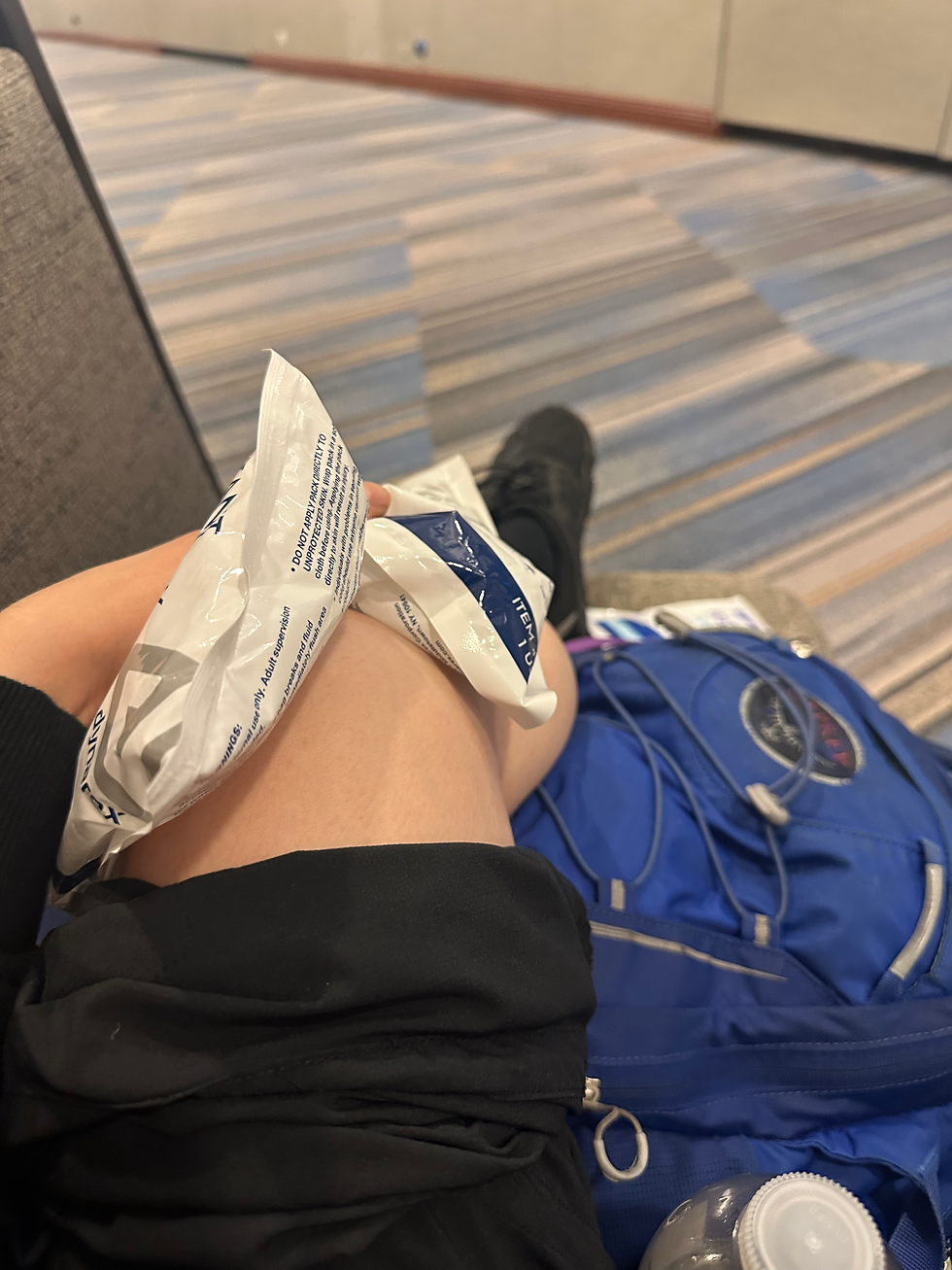
Convention staff carried me to my room. My mentor iced my knee and guided early swelling reduction. The joint remained stuck in flexion. Walking felt impossible.
We ordered a walker, which arrived within two hours. It was bright, shiny pink with red strokes, bold, loud, unmissable. Not what I expected, but exactly what I needed.
Under careful guidance, I took a few tentative steps. The knee stayed bent. I could not straighten it. But a small amount of weight-bearing felt like progress.
The next morning, I attended a few classes at the summit. It was slow, painful, and far from ideal, but I wanted to be present. The improvisation class became unexpectedly emotional. I danced from a chair, following my own advice that dancers can always move within their circumstances. Tears came as I realized I could still dance, even if the shape of my movement had changed. Dancers who had witnessed my fall offered support that softened the fear inside me.
Traveling home required a wheelchair. I learned that the process is less glamorous than it looks, long waits, uncomfortable chairs, and constant motion around me. But it was necessary. When I arrived at O’Hare, my husband brought me home with steady, grounding care.
The Days That Followed
Some things improved that first week post-fall. A hint more extension. Slightly better gait. A touch more weight-bearing ability. Enough improvement to convince me it might not be serious.
I moved forward with my fall class registration planning. I rebuilt my website. I created my course outlines. I assumed I would hobble through my upcoming workshop and return to normal shortly after.
But as the weekend approached, the truth revealed itself. The instability remained. The pain lingered. The knee refused to straighten fully. Emotionally, I was depleted.
I postponed registration. It was heartbreaking. I had been excited to reconnect with my dancers that fall while I was still in Chicago. But uncertainty made every plan feel fragile.
I scheduled an evaluation with a trusted physical therapist. When Friday came, he assessed my knee and quickly grew concerned. He could not diagnose, but he suspected an ACL tear. He could not treat me until I saw an orthopedic doctor.
The word ACL landed heavily. Surgery. Nine to twelve months of recovery. A year of rebuilding. My world felt unsteady again.
I went home and cried.
Sitting With the Possibilities
Over the weekend, I spent hours outside, letting the warm end of Chicago sun and air settle my thoughts. I journaled, reflected, and began a quiet grieving process for the fall season I had imagined. For the move to Denver that now felt more complicated. For the version of full bodied self who had walked into that repertoire class.
I contacted one of my favorite dance PTs, who recommended Dr. Jorge Chala at Rush. I scheduled an appointment for the upcoming Thursday.
During the days that followed, my knee improved slightly. My gait normalized more. My confidence in recovery grew. This is common in ACL injuries; the swelling decreases, and the body creates temporary stability that can mask the severity. But I did not know that yet. I only felt relief building.
When I saw the orthopedic surgeon, he believed an ACL tear was possible but could not confirm without an MRI.
The MRI at the hospital would cost nearly three thousand dollars! After researching more affordable options, we found a center in Skokie that could do it for three hundred seventy-five dollars.
The catch: it would be two weeks before the appointment.
Two more weeks of waiting. Two more weeks of hope mixed with denial.
The Long Wait
When the MRI day arrived, I received a CD of the images. My follow-up appointment with the orthopedic doctor was scheduled for a week later. Curiosity got the best of me, and I wanted to understand what I was looking at.
I compared my MRI to healthy knee images online. I watched videos explaining how to identify ligament injuries. Slowly, I realized I could see my PCL clearly, but I could not see my ACL at all.

It looked exactly like the examples of a torn ACL.
Fear washed over me. I believed, with 90% certainty, that the ligament was gone. The hope I had built collapsed in an instant.
That night, I cried deeply. The kind of crying that comes from fear, grief, and uncertainty all at once.
In the days that followed, I returned to journaling, sunlight, therapy and grounding practices. I tried to hold myself steady. I tried to honor the truth that was unfolding.
The Moment of Truth
When I returned to the orthopedic surgeon, he confirmed it immediately.
I had a fully torn ACL.
Oddly, I was grateful I had prepared myself by reading the MRI beforehand. Had I walked in expecting good news, the shock might have pushed me into shutdown. Instead, I was able to hear and process what came next.
Conversations shifted quickly to surgery. There was no pause between information and action. No space to linger in the in-between. With that said, I knew I was in the best hands and my doctor, Dr. Jorge Chahla of Rush - Midwest Orthopedics, was very thoughtful and spent extra time answer my many questions with honesty and clarity.
One concern weighed heavily on me. I had an October residency with New Trier Dance School and Kinesis. I was serving as master choreographer for the season, and rehearsals were scheduled throughout the month. I did not want to lose that opportunity.
So we scheduled surgery for the closest possible date afterward.
October 31, 2025.Halloween.
A strange holiday gift, but one that marked the beginning of a new chapter.
Where This Chapter Ends
There is much more to share about the month before surgery, the preparation, the fear, the resilience, and the ways the process reshaped my understanding of my body and my artistry. That will come in the next part of this journey.
For now, this story ends with a diagnosis, a scheduled surgery, and a heart learning how to stay steady in a season of uncertainty.
The beautiful moment I met Misty Copeland the day before I tore my ACL.
To anyone navigating injury:
You are not alone.
Your body is still yours.
Your artistry is still alive within you.
And healing, slow, imperfect, unpredictable healing, is still movement.
Thank you for reading this part of my story. There is more to come.

Comments