Behind the Scenes of "How to Be a Betty," Jana's Newest Work & Choreographic Residency:
I am beyond elated to premiere my new work, How to Be a Betty, this Thursday, February 5 at 7:00 pm, Friday February 6 at 7:00 pm and Saturday, February 7 at 2:00 pm as part of a accumulation of a multi-month choreographic residency as the guest and professional choreographer for New Trier’s Kinesis dance company.
You can purchase tickets for $10 here or at the door: https://onthestage.tickets/show/new-trier-high-school/693b291885e242173bea30a5

This piece has been in motion for a long time, beginning last summer when Johannah Wininsky and Katie Kritek, the company directors, reached out about choreographing for the coming year. It was a unique moment in my life. I had just closed my contemporary studio in Wilmette, Skunkworks Dance, and I was planning a move to Denver, Colorado. My availability was not simple, and everything about my life was shifting.

Johannah and Katie were incredible in how they met that uncertainty with support. Together, we shaped the residency in a way that felt more collegiate, more aligned with how many professional and university choreographic residencies operate: I would come in for a concentrated period of creation, then return closer to the performance to set, refine, and deepen. It honored the reality of my transition while still holding the work to a high level.
Then, about a month before the residency began, I tore my ACL in New York City while dancing.
It was the worst injury of my life, completely out of the blue, and it cracked open a very real question: Is this residency even possible? I had a moment of deep doubt. I had a moments of significant grief. I had a moment of fear, both for my body and for the process I had been so excited to begin.
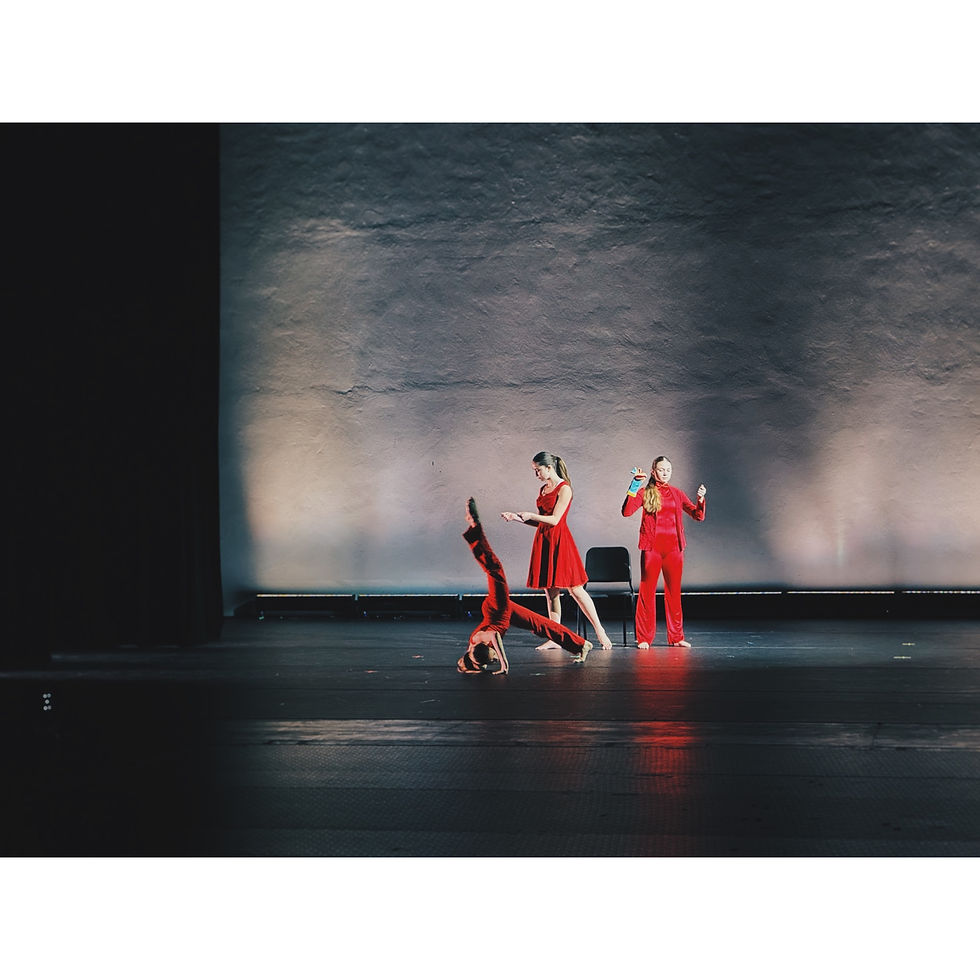
But after a lot of soul-searching, journaling, mindfulness, and honest conversations, I knew something clearly: I still wanted this. I still felt passionate about this piece, about these dancers, and about what was possible, even if the way I moved through rehearsals would look a lot different than what I was used to.
Johannah and Katie held me with such trust and care. They were welcoming, and steady, and with their support, we chose to move forward. In an unexpected way, because of my ACL and the life reshuffling it caused, I ended up being in town more. It gave me more time with the dancers than we originally anticipated, and that became its own gift. The residency did not simply survive. It deepened.
The Beginning: The Brilliance of the Young Women on Stage
How to Be a Betty is, at its heart, inspired by the young women you will see up on this stage.

After auditions, we knew Kinesis would be made up of twenty-five young women. That number alone stopped me in my tracks. It made me think about what it means to be a sophomore through senior right now, to be on the precipice of being eighteen, of being able to vote, of stepping fully into adulthood, and of holding real power to influence society.
When I met the dancers, what struck me was not only their movement ability, but the range of who they are. These are dancers with a wide spread of passions and minds: creativity and artistry, yes, but also journalism, science, math, leadership, and curiosity. They are brilliant. They are hopeful. They are hungry to have a voice, to make change, to make the world better.
And seeing that brilliance, seeing that luminous potential, I could not ignore the cultural moment they are walking into.
Because we are living in a time where two realities exist side by side. There is a world that is pushing women forward, in the workforce, in leadership, in autonomy, in visibility, in choice. But there is also a deeply concerning cultural retreat happening at the same time, a push to return women to a smaller box, to an era of being secondary to men, to an expectation of the household as the only acceptable center, to a narrative where education and voice and self-definition are treated as optional or even threatening.

It is strange to live in 2026 and feel that pull, that backwards trend, emerging so loudly, especially as we watch a generation of young women who are more ready, more intelligent, more passionate, and more capable than ever.
That tension became the pulse of the piece. The question became unavoidable: What does it mean to ignore, look for, see, and choose?
What does it mean to notice a silent fight or problematic structure that has been behind you the entire time, and then decide whether you will step toward it, resist it, walk away from it, or dismantle it?
The Rabbit Hole: Public Domain Television and the Moment Everything Clicked
As these ideas began to emerge, I felt an urge to look at public domain television. Almost immediately, I found The Betty White Show. I am a big fan of Betty White and her pioneering career as a women in media, so it felt like a moment of, “Of course. I have to see this.”
In public domain, there is an episode from 1958 titled Jealousy. The Betty White Show is one of her earlier major roles, a kind of variety sketch show with little scenes and songs, and watching Jealousy was both fascinating and unsettling.

In the first sketch, Betty plays a wife named Lydia. There is a husband, Willard, and there is a Secretary. The sketch is framed through Lydia’s jealousy of the Secretary, and it is done in a way that pits women against women, turning another woman into a threat, an enemy, a rival, while the husband’s behavior is treated as harmless.
Willard flirts and gives attention to the Secretary. Lydia spirals. The Secretary becomes the target of Betty/Lydia's jealousy. And then, at the end, the announcer comes on and instructs Betty’s character, Lydia, to go give Willard, her husband, a kiss because he is innocent.
That moment was creepy. It was chilling. It was also an incredibly clear window into how women were expected to exist, how they were portrayed, and how society framed their emotions as irrational while excusing male behavior as normal.
And what hit me even harder was the cultural nostalgia that still surrounds that era. The time period is still revered by many people today. It is a time period that people still romanticize, and it is also a time period that some people actively want to return women to.
So I could not stop asking: What was it actually like to be a woman in that era? What pressures were invisible because they were normal? What parts of the self had to be flattened , ingored and sacrificed in order to fit the role?

This question opened conversations that mattered deeply to me, including conversations with my mentor, Susan Douglas Roberts. Susan grew up in Texas during that era, and she described something powerful: that at first, growing up in small southern towns, she did not always see the sexism or the structures holding her back. It was normal. It was air. It was the water. But as time went on, she began to notice, to look. Then she began to see the injustices, and finally she choose to create change.
Susan described the shift from looking for little moments, to actively seeing. Not passively noticing, but seeking, identifying, naming. And then beyond that, she spoke about taking action.
That sequence landed in my bones: ignore, look for, see, choose. It became conceptual scaffolding, and it became the choreography’s emotional arc.
Building the Work: Structure as Freedom
I knew from the beginning that this piece needed to be high level, complex, and professional in its scope. It would also be built on a large cast, most of whom I had never met before, let alone worked with.
Because of that, and because I was working through a significant ACL injury, I needed clarity. I needed structure. I needed a framework that would allow the work to move fast without becoming shallow, to be detailed without becoming chaotic.
So once I knew where I wanted to go, I built a draft sound score, because sound is one of the strongest narrative tools I know. I am deeply sound-connected. I love scores, layered sound worlds, and musicality, especially because so much of my work is story-driven. Stories are carried through sound just as much as they are carried through movement.

For this piece, the 1958 Jealousy episode audio became the backbone. It weaves in and out throughout the work as the story evolves, grounding us in that era while allowing the piece to subvert it.
From there, I built a musical world that lives in contrast.

I chose overly cheerful, almost absurd, satirical mid-century music, including “The Choo Choo Cha-Cha” by Rinky Dinks and Hub Atwood, and “Danke Schoen” by Wayne Newton. These songs have that polished, old-world sheen, that surface-level sweetness, that “everything is fine” quality.
But alongside them, I chose current music with loud, visceral, beat-driven composition: music that holds tension, anger, power, and a kind of modern urgency. UVB76 and Osheyack became essential in that regard. Their sound carries weight and rumble. It speaks to what festers beneath the surface, and to what erupts when women stop holding themselves small.
This musical juxtaposition is not just aesthetic. It is conceptual. It is emotional. It blurs time. It asks: Are we watching an old television show, or are we watching ourselves? Is this past, or is it present?
What to Look For: Hands, Puppetry, Gesture, and The Threshold
There are motifs woven throughout the work that matter.
One is hands and gesture. Puppetry and gesture are not just theatrical decoration here. They are language. They are commentary on voice, on control, on who speaks for whom.

Another is The Threshold, representing both, a wall-like systematic structure that seems. to be ingrained deep into society, and at the same time the precipice for real change, living and pushing the "Betty" character forward throughout the piece. A symbol that lives in the juxtapositions of this work and society. I invite you to watch how The Threshold changes, and how the “Betty” character engages with it across space.
This work invites reflection on what The Threshold truly represents, and on the choices we make to ignore it, look for it, see it, or and then make a choice and take action.
Inside the Work:
How the Story Unfolds
Part 1: The Opening: A Hand, A Curtain, A World Constructed
The piece opens with the beginning of the Jealousy episode and soundscore. The first thing you see is a hand, a gesture speaking, a hand imitating speech as Betty White introduces the show. There is an elephant puppet that pops out of the curtains as an announcer comes on the mic. A trio of dancers represents the first mini sketch of Jealousy.
Then the curtain opens and “Betty” enters and sings a monologue about jealousy, and from the beginning I encourage you to notice who is speaking through puppets and who is not.

The “Betty” character is not puppeted, we are in her world. The characters who surround her often are. That is intentional. I encourage you to sit with what that might mean.
At the beginning, you also see The Threshold far away in the background. Betty does not see it. It is behind her. She is fully immersed in her role as a woman of 1958. She is living inside the construct without recognizing the architecture.
Then the scene transforms again. An announcer introduces the scene that will occur, represented by a ballet solo. Ballet, here, is used as a kind of smoothness and polish, an embodiment of a voice that is calm and authoritative, a nod to the era’s aesthetic and a commentary on presentation.
And then the official sketch begins.
Part 2: Lydia, Willard, and the Secretary: Comedy, Satire, and the First Cracks
We meet Lydia, played by “Betty,” and Willard, her husband, represented by the dog puppet. They are at home. Willard needs help with work, so he calls his Secretary and tells her to come over.
This section is comedy through movement and satire. You see “Betty” communicating in an over-the-top physicality, while Willard, as a puppet, moves through a different relationship to voice and responsibility.
During this period, we see The Threshold begin to build for the first time, accompanied by an abstracted sound, a low, rumbling undercurrent that sits just beneath the surface of the scene. Notice how the characters do not see it as it is constructed behind them. It emerges and dissolves without acknowledgement, much like the invisible structures women are taught to accept as “normal,” and at the same time the community that is calling on them to fight and take action.

The dancers move through sharp, angular pathways, punctuated by risk-defying lifts, sudden weight shifts, and expansive jumps that require full commitment and trust. Partner work unfolds with a sense of urgency and instability, bodies passing, catching, and redirecting one another as the space fills with vast physicality. All of this movement accumulates into the gradual assemblage of a wall-like structure.
Betty is happy, immersed. She assumes the Secretary will be older, not a threat, not competition. She opens the door and meets a young, jubilant and beautiful woman.
Enter "Choo Choo Cha-Cha!"
Part 3: “Choo Choo Cha-Cha, ”The Bunny and the Secretary as Innocence
The first musical shift is “The Choo Choo Cha-Cha.” It introduces the Secretary through Betty’s perception, through a kind of exaggerated innocence and youth.
The Secretary enters with a bunny puppet, representing innocence, happiness, youth, and how Betty initially sees her. The ensemble forms a line, bunny-hopping in and then "cha-cha-cha-ing" into the space, almost playful, almost ridiculous, almost too cheerful.

But do not miss what is happening behind the surface.
In the background are three dancers I titled the "Acro Trio," weaving in and out of triangles and partnering work that evokes the jealousy triangle Betty/Lydia is beginning to perceive: Herself, Willard, Secretary. The acrobatics are also a nod to the era’s dance and entertainment style, to that old-world spectacle of bodies flinging into contortion and skill at unexpected times, a kind of cheerful physical bravado inspired by dancers like The Ross Sisters.
The trio embodies both the movement language of the time and the internal workings of what Betty/Lydia is feeling, the triangulation of attention, the instability of self-worth in a world that teaches women to compete for male validation.
The “Choo Choo Cha-Cha” ends with the ensemble connected through the arms into a snake that moves offstage.
This is not accidental. It is the transformation.
Part 4: Bunny to Snake: Seduction, Threat, and the Audience as Witness
In this next musical piece, Betty begins to perceive the secretary differently. She no longer sees her as a bunny. She begins to see her as a snake. A threat. A rival. Someone snaking into her household.

A snake-like line of dancers spirals onto the stage. The movement quality shifts. It becomes thick, specific, almost as if moving through molasses, rippling through the body like a snake’s spine. Watch for contortions and cannons representing the motion of a snake. Watch for flicks, snaps, and moments that bite.
This section is defined by strong rhythmic beats that feel seductive and powerful. It is new-age sound. It is modern. It is not “1958.” And that is the point.
This is also a very important moment in the work. Betty breaks "The Fourth Wall" (a common convention in narrative drama in which a metaphorical, invisible, or imaginary wall separates performers - actors, dancers, singers, etc. - from the audience), moves into the audience, crossing the boundary that says “this is just a show.”

That choice is meant to challenge you.
Are you just watching dancers, or are you part of what is holding women back? Are you part of the change? Are you complicit in the structures you do not name?
Betty sits in the audience and watches as the Secretary entices Willard and Willard flirts back, the dialogue turning into flirtation and puppetry. Betty becomes a viewer, like you. And this is the moment she starts to see her world for the first time as it is, not as she has been told it should be.
She starts to reevaluate her position. She starts to feel her anger. She starts to feel her frustration. She starts to recognize the ways her world binds and diminishes her, and potentially other women. She is looking for the first time.
Part 5: "Danke Schoen”: Showgirls, Ferris Bueller, and the Breakdown of the Perfect Woman
After the intensity of "The Snake Section", the Secretary is given the snake puppet. The epsiode has now marked the Secretary as Betty/Lydia's enemy, the threat coming into her household.

Then the music shifts sharply into “Danke Schoen” by Wayne Newton. The dancers enter in a chorus-girl fashion, sitting on the edge of the stage, challenging the fourth wall with over-presented smiles, waving, smiling, performing.

This music was not chosen only because it belongs to the era. It was also chosen because of its association with Ferris Bueller’s Day Off, specifically the parade scene.
That scene is iconic and funny, yes, but it is also a vivid example of male privilege, of a young man failing upward, receiving attention, being centered, while women orbit his narrative.
That patriarchal pattern moves through time. It persists.
And there is another layer: Ferris Bueller’s relationship to New Trier, to this community, to these roots. It felt impossible not to use.

As you watch this section, look for little Ferris Bueller moments: gestures, echoes of the parade choreography, a reference to the German dancers waving around Ferris, and movement vocabulary inspired by that scene.
The dancers wave with plastered smiles. They embody the perfect showgirl. The perfect woman. Pretty, light, pleasing, and unopinionated led by the Secretary’s vibrant energy.
But then it shifts.

This section reaches a height in unison ensemble choreography, moving from a typical showgirl phrase into what I call "The Showgirl Breakdown." The phrase begins to dissect. Dancers begin to shake, to malfunction, to do things you do not expect. They slip in and out of perfection.
This is the anger beginning to crack through the surface.
It is the internal power and voice rising. It is the old image of womanhood beginning to fall apart.
It parallels Betty’s breakdown of her old self into a new, empowered self, and her recognition of her feelings and seeing the world truly as it is around her.
And at the end of “Danke Schoen,” The Threshold emerges again. This time, watch how Betty looks for it. She wants to see it. She wants to name what is wrong. She wants to rethink the world she has accepted. She actively looks.
Part 6: The Crash Out: Beats, Fight, and the Eruption

Then the piece enters what I call the crash out. It is driven by huge crashing beats from Osheyack, and the tone shifts into something more chaotic, more abstract, more physical.
The stage fills with layers: multi-groups, shifts in spacing, bodies moving in fight-like phrases and powerful, expansive movement. It is the inner turmoil of Betty’s rage, the anger of confinement, the anger of being taught to see another woman as an enemy, the anger of being belittled.
But it is also the eruption of her voice.

There are climaxes where dancers are literally throwing jabs, almost boxing, fight-like movement. Betty/Lydia emerges and the group moves into a massive unison phrase that is the eruption of her feelings, her fight, her anger, fully capitalized through the body.
It ends with Betty throwing herself wildly in all directions. Exhaustion and tension bubbling up to the surface. A physical vow to be different, to refuse, to fight.
And then The Threshold emerges again, pushing her closer and closer to the edge of the stage.

This time, she is one of them.
This time, she sees herself as part of the change. She refuses to live by the problematic systems enforced on her.
She has ignored it. She has looked for it. She has seen it.
And now she chooses. She takes action.
Part 7: The Refusal: Letting Go of Willard, Choosing Women
The Secretary leaves Betty/Lydia's house. Willard comes to hold Betty’s hand. The announcer tells her to forgive him, to kiss him, because he “did nothing wrong.”
This is the moment the original sketch tries to reclaim its ending.

But Betty refuses.
She lets go of Willard’s hand. She lets go of her role in that relationship. She refuses to oblige the announcer’s instruction. She chooses herself. She chooses womanhood. She chooses to see other women as human beings, not enemies.
And then she runs offstage, grabs the Secretary in an act of friendship, and pulls her away.
It is a decision of solidarity. A decision of alliance. A decision of refusing to compete for survival inside a patriarchal construct.
Part 8: The Ending: Improvisation, Joy, and the Audience as Participant
At the end, the stage shifts into big, powerful, joyful improvisation as Lesley Gore's anthem "You Don't Own Me" blasts through the auditorium. The Threshold dissolves. The dancers move into their own voices, their own confidence, their own joy.

Betty and the Secretary make their way up the aisles, improvising loudly, fully, and without apology.
The lights go out on stage, and Betty and the Secretary meet in the middle of the auditorium.
That choice matters to me.

Because this cannot just live on stage. It cannot just live as an idea. You, the audience have a role in all of this. We all have to ask ourselves what role we play in what women are allowed to be, how women are framed, who women are told to compete with, and who women are encouraged to love and support.
Betty and the Secretary go off into the world to live a new life.

And that is the ending I care about.
An ending where women see each other clearly.
An ending where choice is claimed.
An ending where autonomy is not theoretical, but embodied.
What I Hope You Leave With
"How to Be a Betty" is rooted in satire and intensity. It lives in emotional contrast. It begins in an exaggerated, polished, performative femininity that is deliberately artificial, almost cheerful on the surface, while unsettling underneath.

Running beneath that surface is a growing undercurrent of confusion, anger, and rage. As the piece progresses, those emotions sharpen. The choreography leans into discomfort. It exposes what happens when women are compared, confined, and forced into prescribed roles.
By the end, the emotional trajectory shifts toward clarity and choice. The final mood is grounded, powerful, and self-possessed. The work does not resolve through softness. It resolves through strength.
This piece was inspired by the brilliance and luminous potential of the young women on this stage. It explores their power to shape the future amid a wider cultural retreat from women’s autonomy, voice, and self-definition. It asks what it means to ignore, look for, see, and choose.

And it invites you to look for The Threshold.
Look for the wall-like structure. Look for how the “Betty” character changes around it. Look for when she does not notice it. Look for when she begins to seek it. Look for when she finally sees it.
Then ask yourself, gently but honestly: Where are the thresholds in your own world? What do you ignore? What do you look for? What do you see? What do you choose?
Because the work is not only a performance.
It is an invitation.
It is a mirror.
It is a call to witness, and a call to act.
My Final Note The making of How to Be a Betty, and working with New Trier’s Kinesis Dance Company, has truly been the joy and light of my 2025–2026 winter season.
This fall held some of the hardest moments of my dance career. Experiencing the scariest injury I have ever had, one that genuinely made me question how long I might be sidelined from dancing and choreographing, brought me into some very difficult places. At the same time, I was letting go of Skunkworks Dance and the dancers, family and community I loved so deeply, while preparing for an exciting but daunting move to Colorado. It was a season filled with grief, fear, and uncertainty. For a while, it felt like everything familiar was dissolving at once.
This residency changed that.

It gave me joy, freedom, and hope at a moment when I desperately needed all three. Paralleling the work itself, I came to realize that my own "Threshold" was not just artistic, but deeply personal: letting go of a studio, building the courage to move to an entirely new state, and fighting through an injury that can often be career-ending. These were not abstract ideas. They were daily, lived choices.
I am grateful to say that as Betty leaves the work with autonomy, voice, confidence, and joy, I find myself standing in that same place today. I have not felt this happy, excited, or hopeful about the future in a very long time.

I am endlessly thankful to everyone at New Trier High School, the dance department, and the Kinesis dancers for making this experience what it was. A very special and heartfelt thank you to Johannah Wininsky and Katie Kritek for bringing me into this process and for being such grounding, supportive, and generous collaborators throughout. You have become far more than peers. You are friends and artists I deeply revere, and people I know I will carry with me for a long time. Additionally, a big thanks to the New Trier Dance staff for your incredibly warm welcome into your community, which I will forever be greatful.
To the dancers: thank you for giving your full commitment, for being willing to "stay on the bus" and "get comfortable being uncomfortable." Those words mattered because you lived them. You took risks, you trusted the process, and you showed up to this residency with professionalism, courage, and heart. I know this work pushed you outside familiar territory, and I am beyond proud of the openness, focus, and excitement you brought to every rehearsal.

To the Senior Super Vets, thank you for being my right hands in the early days, coming to extra rehearsals, learning material deeply, and helping teach and guide the group when I could not be in my full physicality.
To Allison O'Bara, a former Kinesis and Skunkworks dancer, thank you for helping shape early phrase work when my body could not demonstrate what my mind could see.
Above all, thank you to my family. To my dad, Hank Schneider, and my husband, Brad Bennett, for your endless love, steadiness, and belief in me. Your support has allowed me to heal, to keep creating, and to continue doing what I love with trust and safety around me.

And finally, to my mom, Linda Watson, my partner in dance crime, the woman behind the photos, the puppets, the decorations, my sounding board, and my constant companion at rehearsals. I love you deeply. Sharing this time with you, side by side in the studio, is something I will always hold close.
This residency reminded me that thresholds are not just things we choreograph. They are moments we live through. And sometimes, choosing to step toward them changes everything.
With love,
Jana

Comments